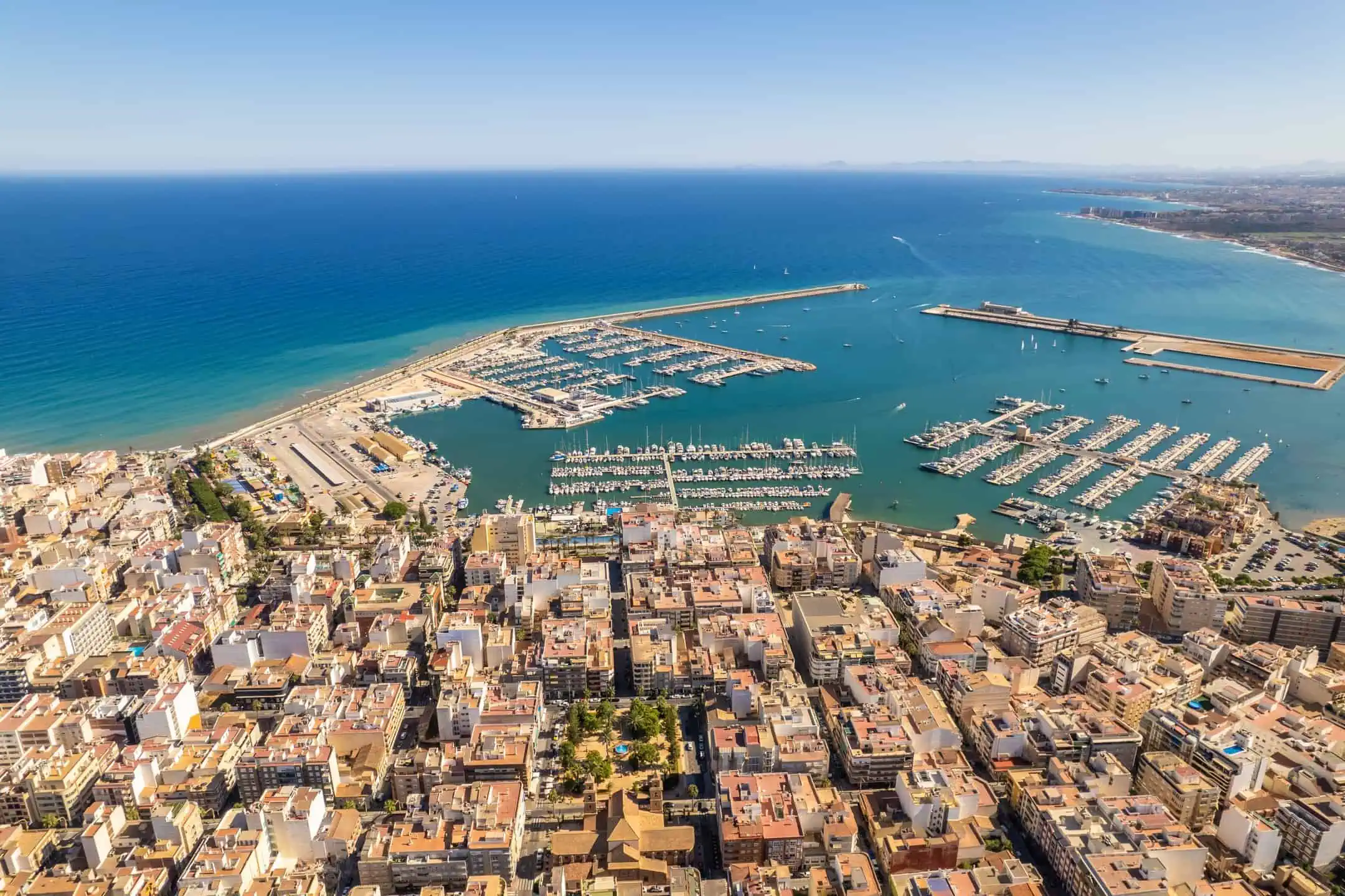
Torrevieja divides opinion like almost nowhere else on the Spanish coast. To its critics, it's overbuilt, unglamorous and relentlessly foreign. To the tens of thousands of Britons, Scandinavians, Dutch and Germans who own here, it's the most practical buy on the Costa Blanca: cheap by coastal standards, alive twelve months a year, and forty minutes from an airport with year-round flights home. Both camps are right. This guide gives you the honest version — prices, the areas worth your money, and the things estate agents won't volunteer.
Is Torrevieja a good place to buy property? Yes — if you want affordability, year-round life and rental demand over charm. Apartments start around €90,000, detached villas from €200,000, and the town has a permanent population of over 90,000 rather than shutting down each winter. The trade-offs: dense construction, ageing housing stock in the centre, and little traditional Spanish character.
Why Torrevieja Keeps Selling
Three things underpin the market here, and none of them is going away.
The climate is genuinely exceptional. The two salt lakes flanking the town — Las Salinas (pink) and La Mata (green) — create a microclimate the World Health Organization has cited as among the healthiest in Europe. Expect around 320 sunny days a year, mild winters, and lower humidity than much of the coast. For retirees with joint or respiratory complaints, this is a real factor, not marketing.
It's a real town, not a resort. Unlike purpose-built holiday urbanisations further down the coast that drop to 10% occupancy in November, Torrevieja has supermarkets, schools, a hospital, a marina, a Friday market and open restaurants in January. Over 100 nationalities live here permanently. If you plan to winter in Spain — or move outright — that matters more than any sea view.
It's cheap. Torrevieja consistently ranks among the lowest price-per-square-metre coastal markets in Spain, at roughly €1,700–€2,200/m² against €3,000–€4,500 in Marbella or Jávea. Volume is enormous: this is one of Spain's most liquid resale markets, which cuts both ways — easy to buy, easy to sell, but nothing here is scarce, so don't expect Mallorca-style appreciation.
Property Types and Price Ranges
The stock splits into four broad bands:
- Older centre apartments (€90,000–€140,000): 1970s–90s blocks near the seafront and old town. Walkable, rentable, cheap — but expect dated interiors, no parking, and communities that may be facing big maintenance bills.
- Modern apartments and bungalows (€140,000–€250,000): the sweet spot. Post-2005 builds and quality bungalow-style townhouses in residential zones, often with communal pools and parking.
- Detached villas (€200,000–€450,000): mostly in the southern and inland urbanisations. €200,000 buys a modest older villa on a small plot; €350,000+ gets a modern build with private pool.
- New build (€250,000–€500,000+): heavy development around Los Balcones, Aguas Nuevas and towards Orihuela Costa. Good specs, ten-year structural warranties, but you're often buying off-plan on the town's expanding edge.
The Best Areas to Buy
La Mata — the northern beach district, and for many buyers the best all-rounder. A proper long sandy beach, its own low-key town centre, the La Mata natural park behind it, and a more relaxed feel than central Torrevieja. Apartments from around €120,000; front-line commands a premium and holds value well.
Playa del Cura — the central beach. Maximum walkability: sea, shops, restaurants and the Friday market on foot. Stock is older and denser, so scrutinise the building, not just the flat. From €100,000 for something needing work; €160,000–€220,000 for renovated with a sea glimpse. Strongest holiday rental demand in town.
Torreblanca — between La Mata and the centre, largely residential with a big Scandinavian and Dutch presence. Bungalows and townhouses with communal pools in the €130,000–€200,000 range. Quiet, well-kept, but you'll want a car.
Los Balcones — south of the salt lake, elevated with lake views and close to Torrevieja's University Hospital — a genuine draw for older buyers. Mix of established villas (from €220,000) and new-build apartments. More space and greenery per euro than anywhere central; the trade-off is a 10-minute drive to the beach.
Lago Jardín — a compact, established urbanisation off the CV-95 popular with budget-conscious buyers. Townhouses and bungalows from €110,000–€160,000 with communal pools. Good value entry point, but it's inland, car-dependent, and quality varies street by street — view several before committing.
What Your Budget Actually Buys
- €200,000: a renovated two-bed apartment near Playa del Cura or La Mata with a communal pool, or a three-bed townhouse in Torreblanca or Los Balcones, or a dated but solid small detached villa inland. In most of coastal Spain, €200k buys none of those.
- €350,000: a modern three-bed villa with private pool in Los Balcones or Aguas Nuevas, or a front-line new-build apartment with sea views. This is where Torrevieja's value argument is strongest.
- €500,000: the top of the local market — a large contemporary villa on a generous plot, or a premium penthouse. Be honest with yourself here: at this level you could also buy in Jávea, Moraira or Altea. Spend €500k in Torrevieja only if the town itself, not the budget, is the reason.
Rental Potential — Realistic Numbers
Demand is real and twelve months long: holiday lets in summer, ~50s wintering from October to March, and a growing long-term market driven by the permanent international population. Gross yields of 5–7% are achievable on well-bought apartments near the beaches — better than most of the Costa Blanca precisely because entry prices are low.
The caveat is regulatory, and it's serious. Holiday lets require a tourist licence (licencia turística) from the Generalitat Valenciana, and since 2024 the regime has tightened sharply: licences now require community-of-owners approval in many buildings, must be renewed every five years, and Torrevieja town hall can restrict new licences by zone. Never buy assuming you'll get a licence — verify before signing, or buy a property with a valid, transferable one. Long-term letting avoids the licence entirely but comes with Spain's tenant-friendly housing laws. Full detail in our guide to renting out property in Spain.
Infrastructure: The Practical Case
- Alicante–Elche Airport is ~40 minutes up the AP-7/N-332, with year-round low-cost routes to the UK, Scandinavia, the Netherlands and Germany. Murcia's Corvera airport is a similar distance south.
- Torrevieja University Hospital is modern, well-regarded, and used to treating in English — a major reason retirees choose the town.
- The N-332 coastal road connects everything but clogs badly in July and August; factor that into any "10 minutes from the beach" claim made in a listing.
- No train station — Torrevieja is car country outside the walkable centre.
The Honest Downsides
Buy with your eyes open:
- It isn't pretty. Decades of rapid construction produced a dense, high-rise centre with little architectural charm. If you're dreaming of a whitewashed Spanish pueblo, this is not it.
- You may barely speak Spanish here — a feature for some, a genuine disappointment for others seeking immersion.
- Older communities carry deferred costs. Many 1980s–90s blocks and urbanisations face lift replacements, façade works and pool repairs. Before buying, demand the community's minutes and accounts for the last three years and check for approved derramas (special levies). Community fees on older complexes with pools and gardens run €600–€1,500+ a year — cheap purchase prices can hide expensive communities.
- Oversupply caps growth. With this much stock, capital appreciation tends to track inflation, not beat it. Buy Torrevieja for use and yield, not speculation.
- August is intense. The population multiplies, parking evaporates, and the seafront is heaving. Some owners love it; know which type you are.
Buying Tips for Torrevieja Specifically
1. Visit in winter. Anywhere looks good in June. Torrevieja's pitch is that it works in January — go and check. 2. Prioritise the building over the flat on older stock: community accounts, pending works, percentage of owner-occupiers. 3. Verify the tourist licence position in writing before paying a deposit if rental income is part of your maths. 4. Negotiate. This is a high-volume market with abundant near-identical stock; asking prices are opening positions, and 5–10% off is routine on resales. 5. Budget the full cost: purchase price + 12–14% buying costs + annual IBI, community fees and non-resident tax.
The Verdict
Torrevieja is the pragmatist's Costa Blanca. It wins on price, climate, healthcare, flights and year-round life, and loses on beauty, prestige and appreciation potential. If you want maximum usable Spain per euro — a lock-up-and-leave that rents well and a town that functions in February — it's arguably the best-value coastal buy in the country. If you want postcard Spain, spend more and go elsewhere. Neither answer is wrong; just know which question you're asking.
Frequently Asked Questions
Is Torrevieja cheap to live in as well as to buy? Yes — day-to-day costs are among the lowest on the Spanish coast. A menú del día runs €10–€14, annual IBI on a typical apartment is €300–€500, and competition among the town's huge service sector keeps everything from dentists to car hire keen.
Which is better for holiday rentals: La Mata or Playa del Cura? Playa del Cura generates more bookings thanks to pure walkability; La Mata attracts longer stays and repeat winter guests. Either works — what matters far more is whether the specific building permits tourist lets and whether a licence is obtainable or transferable.
Is Torrevieja safe? By Spanish standards, yes — crime rates are unremarkable for a town of its size. The usual coastal caveats apply: petty theft around beaches in August, and empty properties should have decent locks and, ideally, a keyholder.
Will a property in Torrevieja go up in value? Modestly. Prices have recovered well since 2015 and new-build demand is strong, but the sheer volume of comparable stock means Torrevieja rarely outperforms. Buy for use and yield; treat capital growth as a bonus.
Do I need to speak Spanish to buy or live here? No. Agents, solicitors, banks and even the hospital operate in English (and often Swedish, Dutch and German). That said, dealing with the town hall and utility companies is still smoother with basic Spanish or a gestor.
---
Ready to look at real numbers? Browse property for sale in Alicante province on Voya →
---
*Prices and regulations referenced are indicative as of 2026 and vary by property and municipality. Always verify licensing rules and community obligations with a qualified Spanish solicitor before purchase.*
Ready to find your property in Spain?
Browse thousands of verified listings from licensed local agents.
Browse properties →